This article shows you how to use common household tools — an electronic scale, a stopwatch, and table salt — to build your own cigar parameter monitoring system, moving from subjective feel to data-driven assessment.
How Hobbyists Can Measure Cigar Humidity, Burn Time, and Basic Parameters with Simple Tools
The rain outside has been falling continuously for three hours, and the damp, muggy cling in the air seeps through even the double-glazed windows. This kind of weather makes it easy to develop an intuitive illusion: is my humidor becoming too humid as well?
For most beginners, judging a cigar's condition usually relies on "feel"—how smoothly it draws, how much resistance there is, whether the smoke feels too heavy. But this feeling is highly subjective and unreliable. Just last week, I suffered a loss because of this "feeling." I had a perfectly stored Partagas that I thought was "a bit dry," so I forcibly placed it into a humidor with excessively high humidity. Within three days, the whole box showed slight signs of mold.
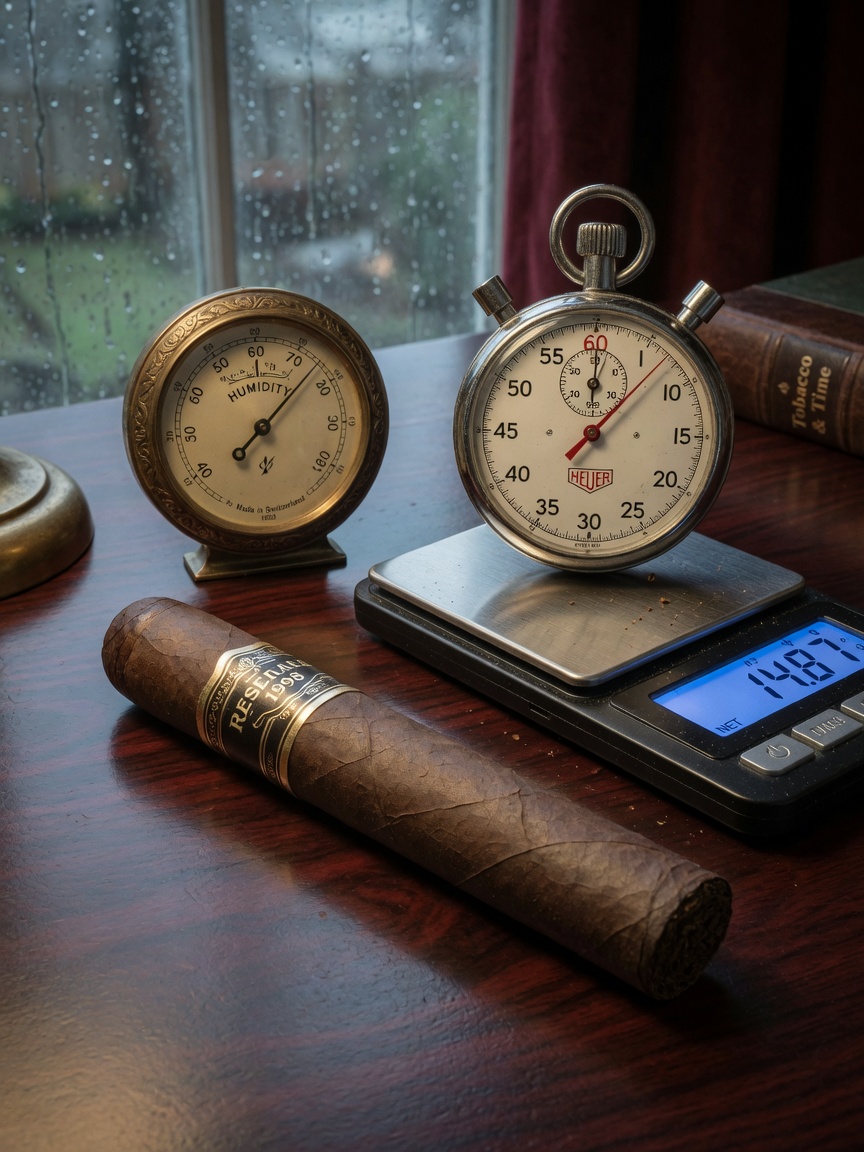
From that day on, I realized that to truly take control of your collection, you must shift from the "feel school" to the "data school." You don't need to buy tens of thousands of dollars worth of professional lab equipment. An electronic scale that can measure to 0.01 grams, a stopwatch on your phone, or even a bag of table salt is enough to build a personal "cigar parameter monitoring system."
Last Saturday afternoon, I decided to put this system into practice and see just how much truth these simple tools could uncover.
The Truth About Humidity Measurement: More Than Just Glancing at a Hygrometer
Many people think that hanging a cheap digital hygrometer in the humidor is all it takes. But practical testing shows that inexpensive sensors have shockingly large errors.
My test setup was in a relatively sealed study room, indoor temperature 24°C, with the hygrometer reading a stable 62%. I prepared two test subjects: one was the cheap digital hygrometer hanging in the humidor, and the other was a "salt test" prepared for calibration.
First, I conducted an experiment on the relationship between weight and humidity. This is a hardcore but extremely effective method.
I selected a large Romeo y Julieta cigar weighing approximately 22.50g. I first recorded its initial weight precisely using the electronic scale, then took it out of the humidor and placed it on the open desk in the study, exposed to the current air environment.
Experimental Data Record:
- Saturday 14:00**: Initial weight 22.50g, humidor hygrometer reading 68%.
- Saturday 18:00**: Weighed 22.42g (4 hours later), weight loss 0.08g.
- Sunday 14:00**: Weighed 22.25g (24 hours later), weight loss 0.25g.
Through this process, I observed a very clear trend: the rate of weight loss is proportional to the difference between ambient humidity. If the ambient humidity is 50%, the weight will drop much faster than at 65%. While I cannot calculate the exact moisture content through simple subtraction alone, the Weight Loss Rate is an excellent early warning indicator. If you find that a cigar's weight drops by more than 1% in 24 hours, your ambient humidity is almost certainly below the safe line of 55%.
Next came the question of hygrometer accuracy. I prepared the saturated salt calibration method. I used a sealed plastic box, filled it with an appropriate amount of table salt, added a small amount of water, and stirred it into a "wet sand" consistency (do not let the salt fully dissolve in the water; keep it semi-dry). Then I placed the cheap hygrometer inside, sealed it, and waited 24 hours.
Calibration Result:
After 24 hours, the cheap hygrometer displayed a reading of 76%, while theoretically, a saturated salt solution at about 25°C should produce a relative humidity of 75.3%. This meant that the hygrometer I had been trusting, which showed 68%, actually had an upward deviation of about 5%.
This experiment taught me a profound lesson: Never fully trust a single reading, especially from inexpensive electronic devices. Your measurement plan must include a regular calibration step (for example, once per quarter).
Combustion Rate Assessment: Using a Stopwatch to Deconstruct the Rhythm of Smoke
If humidity determines a cigar's "personality," then combustion rate determines its "life cycle." A cigar with excessive humidity burns extremely slowly, even going out or smoldering; a cigar that is too dry burns too quickly, causing the smoke to become harsh and hot.
To test combustion rate, I decided to conduct a deconstructive recording session on a Cohiba Siglo VI.
The tools I used were very simple: a phone stopwatch and a marker pen (to mark the burn progress on the cigar wrapper).
Experimental Process and Data:
I divided the cigar into three stages: the first third, the middle third, and the final third.
1. Pre-light preparation: Recorded ambient temperature 24°C, humidity 65%.
2. Stage One (first 1/3): Started timing from lighting. I observed that due to the tight construction of the Siglo VI, the first 15 minutes of burning were relatively stable. When I reached the first third mark, the timer showed **42 minutes**.
3. Stage Two (middle 1/3): This stage began with more intense smoke. As the ash accumulated, the burn rate seemed to slow slightly. When I reached the second third mark, the cumulative time was **95 minutes** (meaning this stage took 53 minutes).
4. Stage Three (final 1/3): In the final stage, due to the changing structure at the end of the cigar, combustion became more vigorous. At the finish, the cumulative time was **145 minutes** (meaning this stage took 50 minutes).
Data Analysis:
Through calculation, I obtained an average burn rate for this cigar of approximately 0.8 mm per minute.
This data point was very meaningful to me. In future reviews, if I encounter a similarly specified cigar that burns through its first third in only 30 minutes under the same conditions, I can immediately judge that the cigar is either overly dry or too loosely rolled, resulting in a lack of smoke density.
This kind of quantitative time-based analysis is far more professional than simply saying "this cigar burns fast," and it helps me build a "standard burn curve" for different brands and sizes in my mind.
The Overlooked Interferences: Limitations of Simple Tools
During this entire testing process, I encountered quite a few unexpected troubles. These troubles are essentially what we call "measurement errors."
First is temperature interference. When measuring weight, I found that if the cigar had just been taken out of the refrigerator (though I don't recommend storing them there) or from a place with a large temperature difference, the electronic scale readings would fluctuate slightly due to changes in air density and momentary moisture condensation. This requires us to let the cigar "rest" at ambient temperature for at least 30 minutes before weighing.
Second is sensor position deviation. When testing the hygrometer, I found that placing it in a corner of the humidor gave a higher reading than placing it in the center. This indicates that the air circulation inside the humidor is not perfectly uniform. My advice is not to rely on a single reading. If conditions permit, place several cheap sensors at different heights and positions in the humidor and take an average, which will be much more reliable than staring at one point.
Finally is operational error. When using a stopwatch to record burn time, human subjectivity (when exactly does it reach "one-third") introduces significant error. I found the best approach is not to rely on eyesight but to use a marker pen to make physical marks on the cigar. Although it looks a bit "violent" and detracts from the cigar's appearance, for enthusiasts who want hardcore data, this is a necessary price to pay.
Enthusiast's Exclusive: At-Home Simple Measurement Plan
Based on this practical test, I have compiled a "parameter monitoring plan" that any ordinary enthusiast can execute at home. This plan does not pursue laboratory-level precision but instead pursues "trend repeatability."
#### 1. Humidity Monitoring (Dual-Track System)
- Daily monitoring**: Place two digital hygrometers inside the humidor (preferably different brands to observe reading deviations).
- Trend monitoring**: Each month, select a representative cigar and record its 24-hour weight change rate in the environment. If the loss is abnormal, immediately check the humidor seal and the lifespan of Boveda packs or similar humidification devices.
- Regular calibration**: Perform a "saturated salt test" every quarter to ensure your electronic hygrometer has not drifted.
#### 2. Combustion Performance Plan (Baseline Method)
- Establish a baseline**: Select a "benchmark cigar" you consider to be in perfect condition (e.g., a classic model you frequently smoke), conduct a full stopwatch timing test under standard conditions, and record its three-stage burn times.
- Comparative testing**: When smoking a new cigar, use the same timing logic for comparison. If the new cigar's burn curve deviates significantly from the baseline (e.g., the first third is shortened by more than 20%), you will have solid data support when writing reviews or making collection decisions.
#### 3. Environmental Parameter Monitoring
- Temperature and humidity recording**: Don't just look at the humidor. Place an independent temperature and humidity sensor in the room where the cigars are stored. In many cases, humidity fluctuations inside the humidor are essentially caused by drastic changes in the room environment.
Conclusion
Measurement is not meant to turn us into cold machines, but to make us more reverent toward this leaf.
When you discover through weighing that humidity is quietly slipping away, and through stopwatch timing that the burn is accelerating, your understanding of a cigar will no longer be limited to sensory perceptions of flavor and taste—it will penetrate to the essence of its physical properties. This transformation from "going by feel" to "going by evidence" is a necessary path for any enthusiast progressing from novice to connoisseur.
Data may not tell you whether a cigar tastes "good," but it can tell you whether it is in its optimal condition.
Feel School vs Data School
Judging by feel
- en
- fr
- br
- jp
- kr
- ru
Speaking with data
- en
- fr
- br
- jp
- kr
- ru
* The salt calibration method is based on thermodynamic principles; at 25°C, the equilibrium relative humidity of a saturated salt solution is 75.3%.